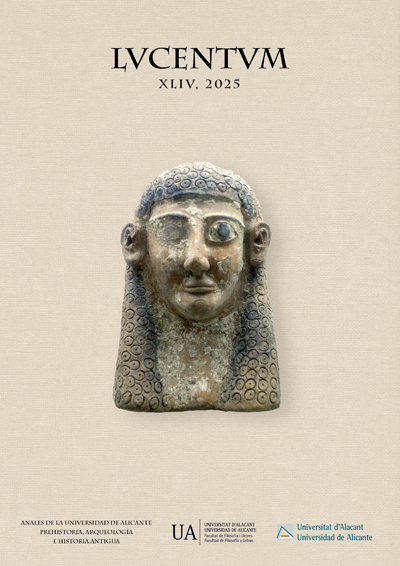
Moneda imperial i representació de Julia Cornelia Salonina (253-268 dC)
DOI:
https://doi.org/10.14198/LVCENTVM.26301Paraules clau:
Salonina, Numismàtica, poder imperial romà, difusió de missatges, segle III dC, ocultacions monetàriesResum
Actualment comptem amb escassa informació sobre Júlia Cornèlia Salonina, fruit de la poca atenció que va rebre per part dels autors clàssics, d'entre els qui li esmenten Aureli Víctor, Zonaràs o la Història Augusta. No obstant això, sabem que va ser dona de Gal·liè, qui va governar entre els anys 253 i 268, per la qual cosa es documenta la seua presència en fonts numismàtiques i epigràfiques. Tenint en compte la importància que tenia la moneda com a suport de difusió de la imatge imperial, en este treball es presenten les característiques de la tipologia de les amonedacions imperials de Salonina. Per a dur-ho a terme, s'han analitzat al voltant de 105.000 monedes de la domus Licinia Augusta presents en 121 tresors de l'Imperi, seguint la metodologia d'investigadors com Duncan-Jones, Noreña o Rowan. El contingut que presentem es divideix en: una introducció; una anàlisi de la informació de Salonina que proporcionen les fonts literàries i epigràfiques, així com un estat de la qüestió; l'estudi de les seues amonedacions; i, finalment, les conclusions. Fruit d'això, podem determinar que existeixen clares diferències entre la tipologia dels períodes 253-259 i 260-268, on se'l va associar principalment amb divinitats tradicionals en el primer cas i amb missatges vinculats a la família imperial, virtuts i divinitats en el segon. A més, gràcies a esta anàlisi es poden reconsiderar algunes de les afirmacions fetes per Cesano, De Blois, Ferrari o Geiger a fi d'avançar en el coneixement de la representació imperial d'esta Augusta.
Referències
Balbuza, K. (2019). The Role of Imperial Women in the Monetary Distributions (Liberalitas) in Rome in the Light of Numismatic Sources. Studia Historiae Oeconomicae, 37, 5-24. http://doi.org/10.2478/sho-2019-0002
Bellinger, A. R. (1956). Greek Mints under the Roman Empire. In. R. A. G. Carson & C. H. V. Sutherland (Eds.). Essays in Roman Coinage Presented to Harold Mattingly (pp. 137-148). Oxford: Oxford University Press.
Bleckmann, B. (2002). Die severische Familie und die Soldatenkaiser. In. Temporini-Gräfin Vitzthum, H. (Ed.). Die Kaiserinnen Roms: von Livia bis Theodorn (pp. 265-339). München: Verlag C. H. Beck.
Callu, J.-P. (2000). Pia Felix. Revue Numismatique, 6(155), 189-207. http://doi.org/10.3406/numi.2000.2282
Calomino, D. (2011). Nicopolis d’Epiro: nuovi studi sulla zecca e sulla produzione monetale. Oxford: British Archaeological Reports. https://doi.org/10.30861/9781407307725
Cesano, S. L. (1951). Salonina Augusta in pace. Atti Della Pontificia Accademia Romana Di Archeologia (Serie III), XXV, 105-121.
Charlesworth, M. P. (1943). Pietas and Victoria: The Emperor and the Citizen. The Journal of Roman Studies, 33(1-2), 1-10. https://doi.org/10.2307/296620
Cohen, H. (1885). Description historique des monnaies frappées sous l’empire romain communément appelées médailles imperiales. Tome Cinquième. Paris: Rollin and Feuardent.
Conesa Navarro, P. D. (2019). Julia Maesa y Julia Soemias en la corte de Heliogábalo: el poder femenino de la Domus Severiana. Studia Historica: Historia Antigua, 37, 185-223. http://doi.org/10.14201/shha201937185223
Crnobrnja, A. N. (2007). Novac carice Salonine i nauk fi lozofa Plotina. Petnicke Sveske, 62, Antropologia, 22-27. https://doi.org/10.4213/rm6849
De Blois, L. (1976). The Policy of the Emperor Gallienus. Studies of the Dutch Archaeological and Historical Society, 7. Leiden: Brill. https://doi.org/10.2307/296620
De Blois, L. (2019). Image and Reality of Roman Imperial Power in the Third Century AD. The Impact of War. London-New York: Routledge. https://doi.org/10.4324/9781351135597
Duncan-Jones, R. P. (1994). Money and Government in the Roman Empire. Cambridge: Cambridge University Press. https://doi.org/10.1017/CBO9780511552632
Eckhel, J. H. (1797). Doctrina Nvmorvm Vetervm. Pars II. Volumen VII. Vienna: Josephi Camesina et Soc.
Eckhel, J. H. (1828). Doctrina Nvmorvm Vetervm. Pars II. Volumen VII. Vienna: Friderici Volke.
Estrada San Juan, G. (2022). Pipa and Gallienus. Hyperboreus, 28(2), 299-320.
Ferrari, M. (1975). La monetazione di Salonina. Numismatica e Antichità Classiche, IV, 239-248.
Flament, C. & Marchetti, P. (2011). Le monnayage argien d’époque romaine: d’Hadrien à Gallien. Athens: École Française d’Athènes.
Geiger, M. (2015). Gallienus. Frankfurt am Main: Peter Lang.
Göbl, R. (2000). Die Münzprägung der Kaiser Valerianus I. / Gallienus / Saloninus (253/268), Regalianus (260) und Macrianus / Quietus (260/262). Wien: Verlag der Österreichischen Akademie der Wissenschaften.
Grunauer-von Hoerschelmann, S. (1978). Die Münzprägung der Lakedaimonier. Berlin: De Gruyter.
Halfmann, Von H. (2005). Gallienus. 253-268. In H. von Manfred Clauss (Ed.). Die Römischen Kaiser (pp. 229-235). München: C. H. Beck.
Hänninen, M.-L. (1999). Juno Regina and the Roman Matrons. In. P. Setälä & L. Savunen (Eds.). Female Networks and the Public Sphere in Roman Society (pp. 39-52). Roma: Institutum Romanum Finlandiae.
Hekster, O. (2003). Coins and Messages: Audience Targeting on Coins of Different Denominations?. In P. Erdkamp, O. Hekster, G. de Kleijn, Mols, S. T. A. M. & L. de Blois (Eds.). The Representation and Perception of Roman Imperial Power (pp. 20-35). Leiden-Boston: Brill. https://doi.org/10.1163/9789004401631_007
Horster, M. (2007). The emperor’s family on coins (third century): Ideology of stability in times of unrest. In O. Hekster, G de Kleijn & D. Slootjes (Eds.). Crises and the Roman Empire. Proceedings of the Seventh Workshop of the International Network Impact of Empire (Nijmegen, June 20-24, 2006) (pp. 291-309). Leiden-Boston: Brill. https://doi.org/10.1163/ej.9789004160507.i-448.78
Horster, M. (2013). Coinage and images of the imperial family: local identity and Roman rule. Journal of Roman Archaeology, 26, 243-262. https://doi.org/10.1017/S1047759413000147
Howgego, C. (1995). Ancient History from Coins. London-New York: Routledge.
Johnston, A. (1997). Greek Imperial denominations in the province of Asia. In J. Nollé, B. Overbeck and P. Weiss (Eds.). Internationales Kolloquium zur kaiserzeitlichen Münzprägung Kleinasiens: 27-30. April 1994 in der Staatlichen Münzsammlung, München (pp. 205-220). Milano: Ennerre.
Kettenhofen, E. (1979). Die syrischen Augustae in der historischen Überlieferung. Bonn: Rudolf Habelt Verlag.
Kienast, D. (2017). Römische Kaisertabelle. Grundzüge einer römischen Kaiserchronologie, Darmstadt: Wissenschaftliche Buchgesellschaft.
Kluczek, A. (2018). Dea Segetia on reverse of coins of empress Salonina. Journal of the Belarusian State University. History, 4, 64-74.
Levick, Barbara (1982). Propaganda and the Imperial Coinage. Antichthon, 16(1981), 104-116. https://doi.org/10.1017/s0066477400002999
Magdalena Anda, J. A. (2022). El emperador Galieno y la supervivencia del Imperio romano. Madrid and Salamanca: Signifer Libros.
Manders, E. (2012). Coining Images of Power. Patterns in the Representation of Roman Emperors on Imperial Coinage, A.D. 193-284. Impact of Empire, vol. 15. Leiden-Boston: Brill. https://doi.org/10.1163/9789004224001
Metcalf, W. E. (2012). Numismatics. In A. Barchiesi & W. Scheidel (Eds.). The Oxford Handbook of Roman Studies (pp. 135-145). New York: Oxford University Pres. https://doi.org/10.1093/oxfordhb/9780199211524.013.0009
Minaud, G. (2012). Les vies de 12 femmes d’empereur romain. Devoirs, intrigues & voluptés. Paris: L’Harmattan.
Nadolny, S. (2016). Die severischen Kaiserfrauen. Stuttgart: Franz Steiner Verlag. https://doi.org/10.25162/9783515113151
Nony, D. (1982). À la recherche de Segeta. Bulletin de la Société nationale des Antiquaires de France, 1978(1), 244-246. https://doi.org/10.3406/bsnaf.1982.8695
Noreña, C. F. (2001). The Communication of the Emperor’sVirtues. The Journal of RomanStudies, 91, 146-168. http://doi.org/10.2307/3184774
Noreña, C. F. (2011). Imperial Ideals in the Roman West. Cambridge: Cambridge University Press.
Okoń, D. (2018). Several Remarks on the Cult and the Titulature of Empresses from the Severan Dynasty. Mnemon, 18(2), 142-149.
Rowan, C. (2011). The public image of the Severan women. Papers of the British School at Rome, 79, 241-273. http://doi.org/10.1017/S0068246211000031
Rowan, C. (2012). Under Divine Auspices. Divine Ideology and the Visualisation of Imperial Power in the Severan Period. Cambridge: Cambridge University Press.
Sage, M. M. (1983). The persecution of Valerian and the peace of Gallienus. Wiener studien, 96, 137-159.
Sánchez-Conde, F. J. & Blázquez Cerrato, M. C. (2022). Iconografía numismática de las virtudes imperiales: Pietas en las monedas de Antonino Pío. Omni, 16, 171-192.
Serrano Ordozgoiti, D. (2020a). Autorappresentazione imperiale della domus Licinia Augusta nell’epigrafia latina del nord d’Africa (253-268 d.C.): una nuova sintesi. In S. Aounallah & A. Mastino (Eds.). L’Epigrafia del Nord Africa: Novità, Riletture, Nuove Sintesi (pp. 93-104). Faenza: Lega Editori.
Serrano Ordozgoiti, D. (2020b). Imago per Aedificis: la Domus Licinia Augusta (253-268) y la epigrafía edilicia en el norte de África en la mitad del siglo III d.C. In I. Velázquez
Soriano & S. Madrid Medrano (Eds.). Testimonios epigráficos edilicios: Antigüedad y medievo (pp. 289-333). Madrid: Guillermo Escolar Editor.
Serrano Ordozgoiti, D. (2021a). Centrum et peripheria: imagen y autorrepresentación del poder de la domus Licinia Augusta (253-268 d. C.) hispanas a través de su epigrafía en las provincias. Cuadernos de Arqueología de La Universidad de Navarra, 29, 205-234: https://doi.org/10.15581/012.29.003
Serrano Ordozgoiti, D. (2021b). Puerta Esquilina de Roma (Italia) con inscripciones en honor de Galieno y Salonina. Boletín del Archivo Epigráfico, 7, 20-38.
Serrano Ordozgoiti, D. (2021c). Placa de mármol en honor de Galieno y Salonina proveniente de Falerii Novi (Italia). Boletín del Archivo Epigráfico, 8, 16-27.
Sirano, F. (2003). Una nuova dedica a Gallieno e Salonina (Mater Castrorum) da Teanum Sidicinum. Aspetti della propaganda imperiale nella Regio I. Rendiconti Dell’Academia Di Archeologia Lettere e Belle Arti, 72, 95-124.
Sutherland, C. H. V. (1983). The Purpose of Roman Imperial Coin Types. Revue numismatique, 6(25), 73-82. https://doi.org/10.3406/numi.1983.1838.
Touratsoglou, I. (1988). Die Münzstätte von Thessaloniki in der römischen Kaiserzeit (32/31 v.Chr. bis 268 n.Chr.). Berlin & New York: De Gruyter.
Varner, E. (2001). Portraits, Plots, and Politics: «Damnatio memoriae» and the images of Imperial Women. Memoirs of the American Academy in Rome, 46, 41-93. https://www.jstor.org/stable/4238780
Wagenvoort, H. (1980). Pietas. In Versnel, H. S. (Ed.). Studies in Greek and Roman Religion (pp. 1-20). Leiden: Brill. https://doi.org/10.1163/9789004296688
Wallace-Hadrill, A. (1986). Image and Authority in the Coinage of Augustus. The Journal of Roman Studies, 76(1986), 66-87.
Webb, P. H. (1927). The Roman Imperial Coinage. Vol. V.1. London: Spink & Son.
Descàrregues
Estadístiques
Publicades
Com citar
Número
Secció
Llicència
Drets d'autor (c) 2025 Adrián Gordón Zan

Aquesta obra està sota una llicència internacional Creative Commons Reconeixement-NoComercial-CompartirIgual 4.0.